
By Ryan
Published on Dec 3, 2025
WhatsApp Business API for Manufacturing: 9 B2B Use Cases
Emails get buried. Calls eat hours. Manufacturing B2B runs on fragmented communication — until WhatsApp Business API fixes it. This guide covers 9 real use cases, from instant quote-to-payment flows to automated order tracking and supplier coordination.
In manufacturing B2B, a 5-minute delay in answering a dealer's price query can mean a lost order to a competitor who replied first. Yet most manufacturers still run supplier and buyer communication through buried emails, missed calls, and scattered spreadsheets — tools built for a slower era of B2B. WhatsApp Business API changes the math: 98% open rates, instant quote-to-payment flows, and automated order tracking, all inside the app your dealers already check 50 times a day. Here are 9 real use cases showing exactly how manufacturers are using it to cut response times, speed up payment cycles, and close more deals.
📢 demand -> 💬 engagement -> 👥 leads -> 💬 conversations =>💰 revenue
What is WhatsApp Business API?
WhatsApp Business API is Meta's messaging solution for businesses. Designed primarily for medium to large businesses, going beyond the basic WhatsApp Business app. It enables scalable, automated communication on WhatsApp, including:
- Handling high-volume messages with multiple users or teams sharing one verified business number (green tick for credibility).
- Automating responses via chatbots, template messages, and integrations with tools like Zoho, SAP, or custom ERPs.
- Sending rich media such as PDFs, images, videos, and interactive buttons for catalogs, quotes, or order forms.
- Compliance with WhatsApp's policies for marketing, utility, and customer service messages, with end-to-end encryption for secure B2B dealings.
💡Unlike the free business app, the WhatsApp API requires an Official Meta provider like Chakra to set up and manage. Chakra Chat simplifies onboarding (often live in 15 minutes), offers coexistence to register an existing WhatsApp number, and provides advanced features like multi-number support and analytics – making it ideal for manufacturing teams handling suppliers and distributors.
Customer Engagement Challenges: Manufacturing
The manufacturing sector faces unique pain points in B2B communications, especially with suppliers and partners. These challenges can lead to delays, errors, and lost opportunities, but WhatsApp Business API, via platforms like Chakra Chat, offers targeted solutions:
- Fragmented Communication Channels: Emails get buried, phone calls are time-consuming, and scattered tools lead to miscommunication between production teams, suppliers, and buyers.
- Supply Chain Visibility Issues: Tracking inventory, production schedules, and deliveries often involves manual updates, causing delays in supplier coordination.
- Slow Order Processing and Follow-Ups: B2B orders involve quotes, negotiations, payments, and confirmations – processes bogged down by paperwork and back-and-forth.
- Compliance and Documentation Sharing: Sharing technical specs, compliance certificates, or quality reports securely is cumbersome via email attachments.
- High Costs of Traditional Outreach: SMS campaigns or calls for supplier engagement are expensive and have low engagement rates.
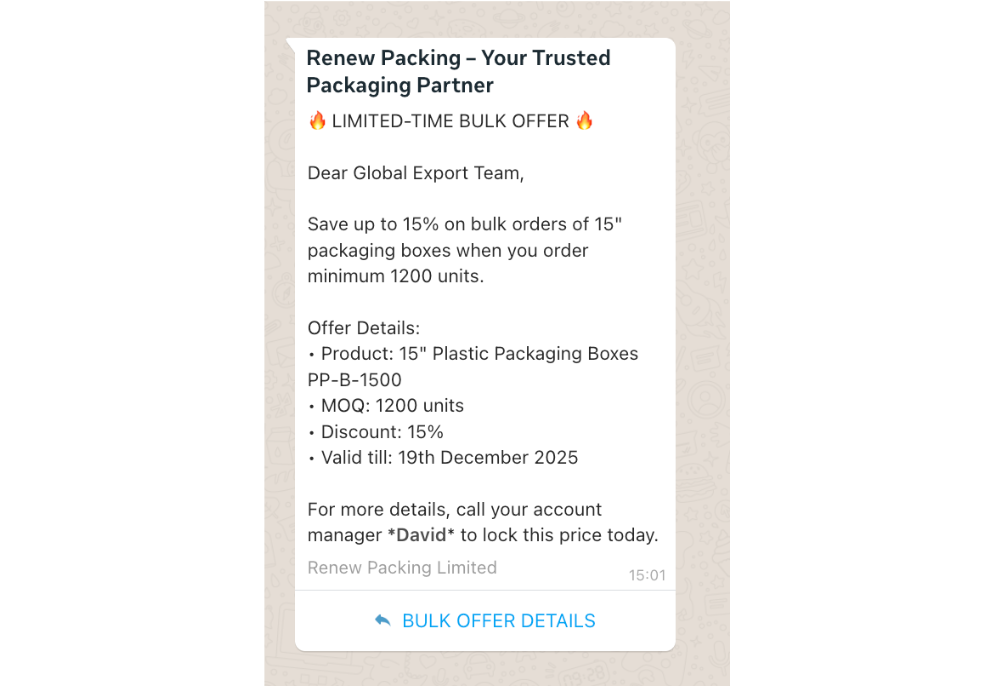
Everyday Pain Points in Manufacturing B2B – WhatsApp solves
| Challenge | Old Way | WhatsApp + ChakraHQ Chat Reality |
| Dealer calls 5 times asking for latest price list | Email Excel / PDF that gets ignored | Dealer types “Price” → instantly receives updated PDF with validity |
| Procurement team chasing order status | Endless calls & emails | Auto-notifications at every stage: Confirmed → Invoiced → Dispatched → Out for delivery + live tracking link |
| Payment follow-ups eating 3–4 hours daily | Phone calls & SMS | Gentle reminder + UPI QR / payment link → customer sends screenshot in 30 sec |
| Sharing heavy test certificates & drawings | WeTransfer / Google Drive links | Send 50MB PDFs directly in chat – opens instantly |
| Multiple sales guys messaging same dealer | Confusion & unprofessionalism | Single verified number; all chats visible to entire team in ChakraHQ dashboard |
💡By addressing these, WhatsApp Business API helps manufacturers cut operational inefficiencies by up to 60-80%, as seen in real implementations.
Use Cases of WhatsApp API in Manufacturing
Drawing from industry examples, here are practical B2B use cases where WhatsApp Business API shines for manufacturers. Chakra Chat enhances these with its AI-driven automation and easy setup:
| # | Use Case | How ChakraHQ Chat Makes It Happen | Business Impact |
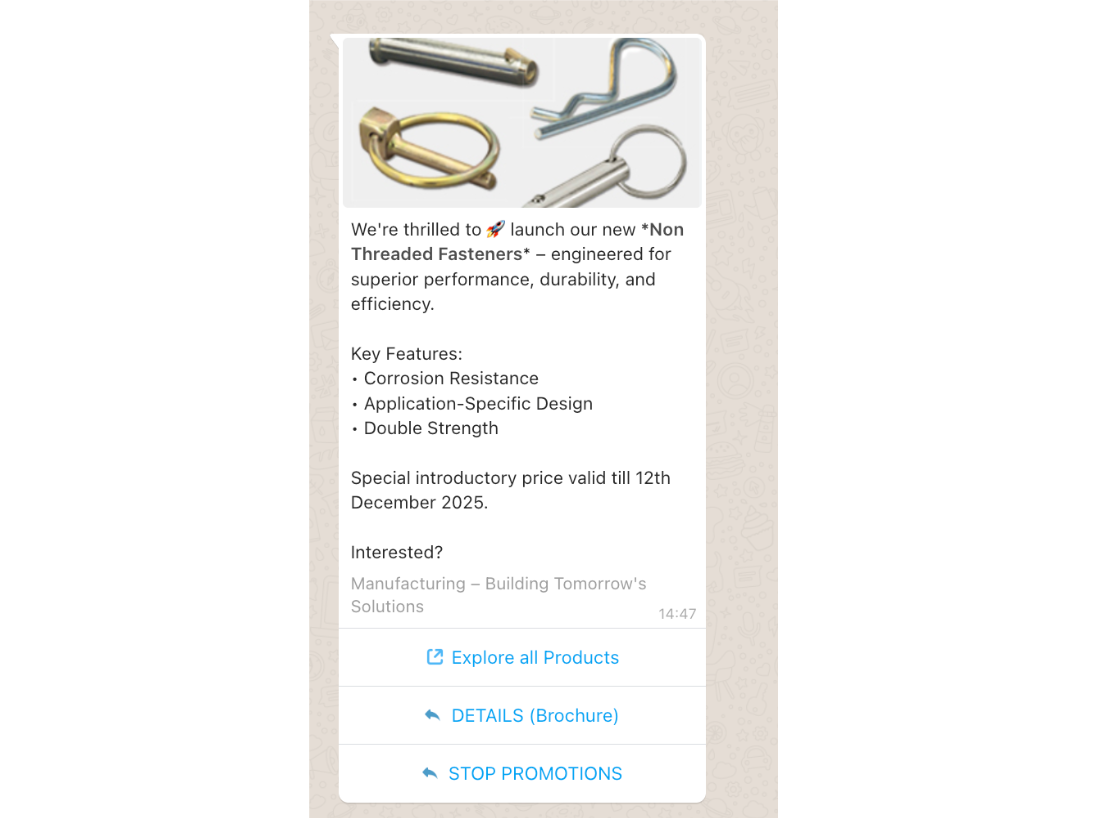
| 1 | Generate Demand at Scale | Broadcast to 10,000+ dealers/prospects daily (new launches, offers, catalogs) with buttons, PDFs, images. 98% open rate, 50% click rate. Drip campaigns + delivery tracking. | 3–5× more inquiries than email/SMS |
| 2 | Instant Inquiry Handling | 24/7 AI chatbot + auto-routing to correct sales/executives. Sticky agent assignment so the same manager always handles the dealer. | Response time <30 sec, 40–60% higher conversion |
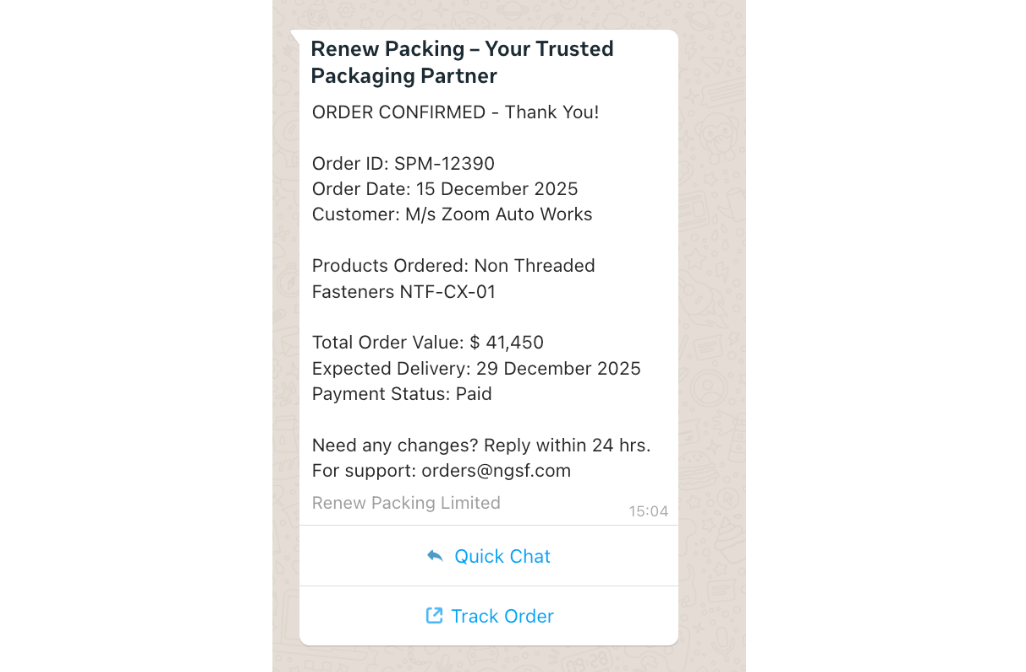
| 3 | Quote → Payment → Order in One Chat | Buyer asks price → AI sends latest quote PDF + UPI/payment link → payment proof uploaded → order auto-created in ERP/Tally. | Payment cycle cut from 45 to <7 days |
| 4 | Live Order & Delivery Updates | Automated triggers: Confirmed → Invoiced → QC Passed → Dispatched + live tracking link. | 80–90% drop in “where is my order?” calls |
| 5 | Complex Product Queries on Auto-Pilot | Train Chakra AI once on your full catalog, pricing, specs. Dealer asks technical questions → accurate AI reply in seconds. | 70% queries handled without human touch |
| 6 | On-the-Go Team Access | Chakra iOS/Android app — sales & plant teams reply, share files, close deals from anywhere. Full desktop sync. | Zero missed opportunities even outside office |
| 7 | Payment Reminders & Collections | Auto reminders 3 days before the due date with payment link. Payment screenshot → auto-reconciled. | Overdues reduced by 50–70% |
| 8 | Post-Delivery Feedback & Loyalty | Auto NPS survey after every delivery. Low score → immediate manager alert. High score → loyalty offer. | Higher retention + valuable product feedback |
| 9 | Zero Disruption Switch | Link your existing WhatsApp Business App number to ChakraHQ (Co-existence). Keep all chat history, contacts, and continue using both apps side-by-side. | Smooth migration in 48 hours |
Key Advantages of Using WhatsApp
Adopting WhatsApp Business API offers manufacturing businesses a competitive edge in B2B:
- Unmatched Engagement: 98% open rates and instant responses beat email/SMS, fostering trust with suppliers.
- Cost Efficiency: Free for inbound messages; low costs for outbound, bring down communication expenses.
- Scalability and Automation: Handle thousands of chats with AI chatbots and integrations, freeing teams for high-value tasks.
- Security and Compliance: End-to-end encryption protects sensitive B2B data like contracts or pricing.
- Multi-Team Collaboration: Shared inboxes and multi-number support ensure coordinated efforts across sales, supply chain, and support.
- Data-Driven Insights: Chakra Chat's analytics track message performance, helping optimize supplier engagement.
- Quick ROI: Go live fast with Chakra Chat's easy setup, seeing results like faster order cycles and higher retention.
💡Real companies, from heavy machinery to production firms, are already reaping benefits – reducing lead times and boosting business by 10-25%.
TL;DR
Manufacturing B2B runs on fragmented emails, slow phone follow-ups, and manual order tracking — WhatsApp Business API fixes all three at once. Here's the breakdown:
Core problems this solves:
- Fragmented communication — scattered emails and calls cause miscommunication between production, suppliers, and buyers
- Supply chain visibility gaps — manual updates delay inventory and delivery coordination
- Slow order processing — quotes, negotiations, and payments bogged down by paperwork and back-and-forth
- Compliance document sharing — technical specs and certificates are cumbersome to share securely via email
9 use cases covered:
Demand generation at scale — broadcast to 10,000+ dealers daily; 98% open rate, 3–5x more inquiries than email/SMS
Instant inquiry handling — 24/7 AI chatbot with auto-routing; response time under 30 seconds
Quote-to-payment in one chat — AI sends quotes, takes payment links, auto-creates orders in ERP/Tally; payment cycle cut from 45 to under 7 days
Live order & delivery updates — automated status triggers; 80–90% drop in "where is my order?" calls
Complex product queries on autopilot — AI trained on catalog and specs handles 70% of technical questions
On-the-go team access — mobile apps for sales and plant teams; zero missed opportunities
Payment reminders & collections — automated reminders with payment links; overdues reduced by 50–70%
Post-delivery feedback & loyalty — automated NPS surveys trigger manager alerts or loyalty offers
Zero-disruption migration — coexistence lets you link your existing WhatsApp number without losing chat history
Bottom line: Manufacturers using WhatsApp Business API are seeing 60–80% cuts in operational inefficiencies and 10–25% growth — because the channel meets suppliers and buyers where they already are, with the speed B2B deals actually require.